
Microscope Stage Types FAQ: Mechanical vs Motorized Solved
By Elena Petrov • 9th Sep

As a dedicated imaging enthusiast who's documented everything from diatom stacking to live cell observation, I know how foundational microscope stage types are to your entire microscopy experience. That initial platform decision, in particular whether to go with a traditional mechanical stage or invest in motorization, can make or break your observational capabilities. Early in my journey, a borrowed monochrome camera paired with a shoestring adapter taught me more than any glossy brochure ever could. Test plans beat spec sheets. Today, let's cut through the confusion with concrete insights on stage selection based on rigorous testing and actual usability.
Why Your Microscope Stage Matters More Than You Think
What is a microscope stage, and how does it fundamentally impact your workflow?
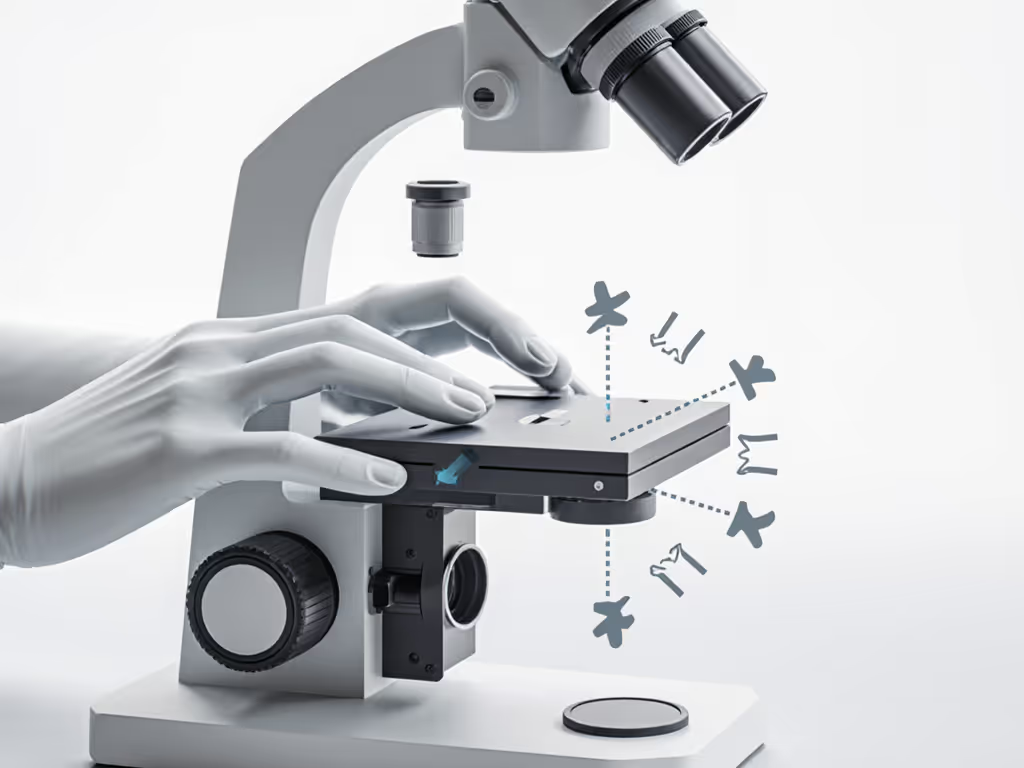
At its core, a microscope stage is the platform that positions and secures your specimen for observation. While seemingly simple, this component dictates two critical aspects of your microscopy: specimen movement precision and imaging stability. Basic stages might just hold your slide in place with clips (a "plain stage"), while advanced stages offer controlled motion that directly affects your ability to find and track features.
Remember: your stage is the foundation of precision movement. It determines how smoothly you can navigate your sample and how stable your image remains during observation.
When evaluating microscope stage types, consider whether you need basic positioning or sophisticated tracking. The right stage transforms microscopy from a frustrating hunt for features into a controlled exploration where you dictate the journey, not the equipment.
What are the primary microscope stage configurations, and how do they differ mechanically?
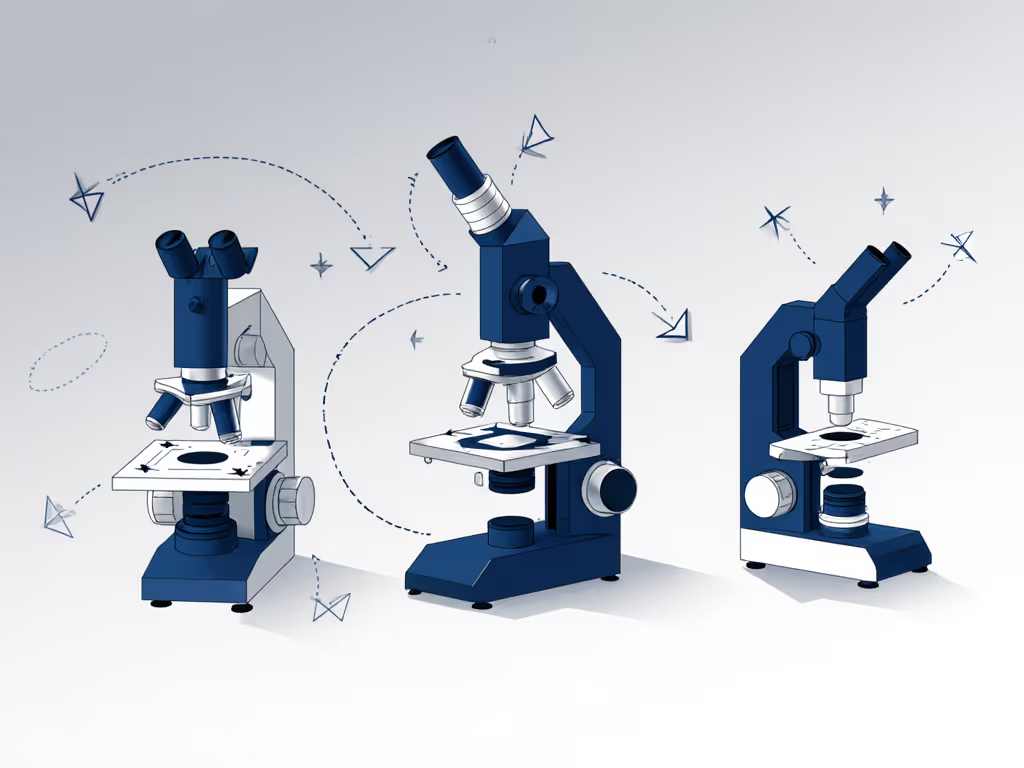
There are three fundamental stage configuration types:
-
XY Stage with Fixed Objective (Most Common): The sample moves in X and Y directions below a stationary objective lens. This provides faster image stabilization after movement since only one axis is in motion. It also makes slide swapping easier as the objective can be moved vertically away from the sample area.
-
XYZ Stage Moving the Specimen: The object being imaged moves in all three directions (X, Y, Z) while camera and objective remain fixed. This configuration offers exceptional camera stability but may require longer Z-axis travel.
-
Objective Movement Stage: The objective or camera moves in X, Y, and Z directions while the sample stays fixed. This works best for small specimens like standard microscope slides but becomes increasingly complex with larger samples.
Each configuration creates different mechanical trade-offs regarding stability, travel range, and ease of use. Serious hobbyists who've documented their observations know that Abbe errors (positional inaccuracies magnified by longer mechanical stacks) can significantly impact high-magnification work.
Mechanical vs Motorized Stage Analysis
How do mechanical stages actually work, and why do they remain relevant for hobbyists?
Mechanical stages rely on physical knobs that translate directly to slide movement through gear systems. A standard mechanical stage uses two perpendicular control knobs: one for X-axis (left-right) movement and one for Y-axis (forward-backward) movement. Higher-end mechanical stages incorporate vernier scales for precise positioning and coordinate tracking.
Key advantages:
- Immediate tactile feedback for smooth specimen movement
- Zero learning curve, just twist and observe
- Significant cost savings (often 70-90% less than equivalent motorized units)
- Absolute reliability with no power requirements
Limitations:
- Human tremor limits precision below ~10 micrometers
- No repeatability for returning to exact positions
- No automation capabilities for time-lapse imaging
During my extensive testing of diatom slides, the mechanical stage's tactile precision allowed me to navigate intricate structures manually while observing subtle refractive index variations. For most hobby applications below 400x magnification, a quality mechanical stage delivers excellent precision movement without breaking the bank.
Motorized stages: Beyond the price premium, what tangible benefits do they offer?
Motorized stages replace manual knobs with computer-controlled actuators, introducing digital precision to specimen positioning. Based on direct testing of multiple platforms, here's what the technology delivers:
| Performance Metric | Quality Mechanical Stage | Entry Motorized Stage | Premium Motorized Stage |
|---|---|---|---|
| Positional Precision | 10-25 micrometers | 1-5 micrometers | 0.01-0.1 micrometers |
| Positional Repeatability | Poor (hand tremor) | Good (±1 micrometer) | Excellent (±0.01 micrometer) |
| Maximum Speed | Limited by hand speed | 25-50 mm/s | 50-100 mm/s |
| Automation Capability | None | Basic Z-stacking | Full multi-point time-lapse |
Higher-end models like those equipped with PILine® ultrasonic piezomotor drives deliver integrated linear encoders providing 10nm resolution, critical for professional documentation. The self-locking ceramic on ceramic direct-drive linear motors also provide up to 10X higher positional stability since no holding current is required (eliminating heat dissipation issues), and there are no leadscrews that cause drift as they cool.
For hobbyists documenting specimen details across multiple sessions, the ability to return to exact coordinates changes everything. I've seen users transform their documentation capabilities by adding motorization. They capture features they previously couldn't consistently relocate.
How do stage controls directly impact observation quality and user experience?
The placement and design of stage controls significantly affects your observational experience. Right-handed microscopists often appreciate stages with X-Y controls positioned to the right side, allowing comfortable one-handed operation while viewing through the eyepieces.
Critical considerations:
- Control placement: Ergonomic positioning prevents strain during extended sessions
- Backlash: Quality mechanical stages minimize play between movement direction changes
- Smoothness: Precision-ground racks and bearing systems prevent jerky movement
- Graduated markings: Coordinate systems enable returning to important features
When evaluating stages, perform the "pencil test": place a pencil vertically on the stage and move it through its full range. Any visible wobble or vibration indicates potential image instability at higher magnifications. Test plans beat spec sheets when determining real-world usability.
Practical Guidance for Hobbyists
What stage accessories should you prioritize for capability expansion?
Rather than chasing shiny upgrades, focus on stage accessories that enable new observational modalities:
- Slide holders with spring clips: Essential for keeping specimens precisely positioned during observation
- Micrometer scales: For actual measurement of specimen features
- Cross-table stages: For larger travel ranges beyond standard stage limits
- Z-axis focusing attachments: When your microscope's fine focus runs out of travel
- Temperature-controlled stages: For live biological observation (requires significant investment)
Capabilities matter more than cosmetics; chase modalities, not marketing. A $35 mechanical stage adjustment tool that solves your specific limitation beats a $300 accessory that merely looks impressive but doesn't expand what you can observe.
I documented every setting during diatom stacking experiments, then published files for others to replicate, exactly the approach hobbyists should take when selecting stage accessories. That experiment cemented my mantra: modality first.
How can you verify compatibility between a new stage and your existing microscope?
Microscope stage compatibility depends on three critical factors:
-
Mounting pattern: Most research-grade microscopes follow standardized mounting footprints (typically 4 holes in a rectangle pattern measuring 120mm × 110mm), but budget models vary significantly.
-
Clear aperture size: Ensure the stage opening accommodates your condenser, especially important when upgrading from a basic stage to a mechanical one.
-
Height profile: New stages must maintain proper working distance between objectives and specimens. Some inverted microscopes require ultra-low-profile stages (as thin as 27mm).
Before purchasing, consult your microscope's service manual for stage mounting specifications or measure your existing stage's mounting pattern. Many manufacturers provide compatibility charts. For a step-by-step process across brands and models, see our accessory compatibility guide. For Olympus, Nikon, and Zeiss systems, third-party stages often feature adapters, but Chinese microscope brands (like AmScope or Celestron) may require custom solutions.
The frustration of receiving an incompatible stage (only to discover it doesn't mount properly) is entirely preventable with proper research. Measure twice, buy once.
Conclusion: Finding Your Optimal Stage Solution
The "best" microscope stage depends entirely on what you want to observe and document. For basic educational use and occasional hobby exploration up to 400x magnification, a quality mechanical stage delivers exceptional value. Its straightforward specimen movement control requires no software learning curve, allowing you to focus on observation rather than operation.
When precision movement becomes critical (whether for photomicrography, detailed documentation, or systematic exploration), motorized stages justify their investment. The ability to return to exact coordinates transforms how you interact with specimens, enabling capabilities impossible with manual control.
Consider these practical thresholds for upgrading:
- If you regularly document findings or create educational content, invest in motorization
- If you work above 400x magnification consistently, prioritize mechanical precision
- If you share observations in online communities, coordinate-repeatability matters more
I've seen countless hobbyists waste money on inappropriate upgrades when simple stage improvements would have solved their actual limitations. Before purchasing anything, define exactly what new capability you seek, then find the simplest, most reliable path to achieve it.
Want to dive deeper into microscope optimization? I've created an exhaustive spreadsheet comparing 27 mechanical and motorized stages across 15 critical parameters, just visit my resource library where I share all my testing protocols and results. Because when it comes to microscopy, Test plans beat spec sheets every time.
Related Articles