CMOS vs CCD for Microscopy: Sensor Guide
By Asha Raman • 3rd Mar
When you're hunting for a better microscope camera, the question of CMOS vs CCD for microscopy often emerges as the first technical hurdle. Both sensor types convert light into electronic signals that become your digital images, but they do it through fundamentally different architectures, and those differences matter far more in real world microscopy than marketing materials suggest.
Choosing between them isn't about picking the "better" sensor. It's about matching your specific imaging needs to the sensor's actual strengths. The right choice delivers measurable improvements in image clarity, capture speed, or light sensitivity at a price that justifies the upgrade.
How CCD and CMOS Sensors Actually Differ
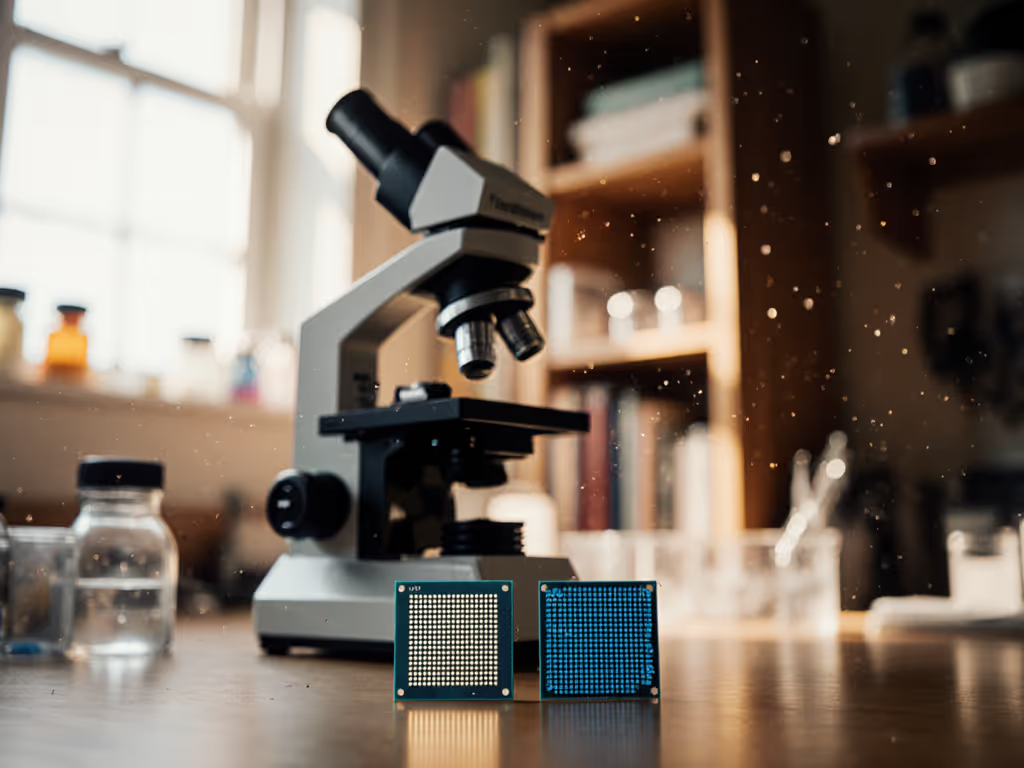
The distinction starts at the silicon level. CCD sensors use a serial charge transfer process: light hits each pixel, generates charge, and then that charge travels row by row across the chip to a single output amplifier. One amplifier reads the entire sensor. This centralized architecture keeps noise low, a significant advantage for microscopy where stray electrons introduce artifacts that obscure fine detail.
CMOS sensors, by contrast, put an amplifier at each pixel. This parallel design lets every pixel convert its charge to voltage independently, without queuing up for a central processor. That parallel readout speed is substantial.
Think of it this way: CCD is a single-lane toll booth processing cars sequentially; CMOS is a parking garage with an exit at every level.
Critical Performance Metrics for Microscopy Imaging
Quantum Efficiency and Low-Light Capture
In microscopy, you often work with dim specimens or high magnifications where light is scarce. Quantum efficiency (the percentage of photons that become usable signal) directly controls whether you capture fine cellular detail or end up with a noisy, unusable frame.
Traditionally, CCD sensors held a clear edge here. Their single amplifier and serial transfer process preserved signal integrity in low-light conditions, delivering quantum efficiencies that CMOS struggled to match. For demanding applications like fluorescence microscopy or deep tissue imaging, CCDs were the default choice. If fluorescence is central to your work, see our fluorescence accessories guide for filter cubes, light sources, and practical setup tips.
However, CMOS has narrowed that gap significantly. Innovations like backside illumination (BSI), where light enters from the back of the sensor rather than through metal circuitry on the front, have improved CMOS quantum efficiency to competitive or even superior levels. Modern scientific CMOS (sCMOS) sensors now achieve sensitivities rivaling traditional CCDs, a fact confirmed by recent industry reports.
Dynamic Range: Capturing Weak and Bright Signals Simultaneously
Dynamic range measures a camera's ability to capture both dim and bright areas in the same frame without losing detail to shadows or blown out highlights. CCD sensors typically offer higher dynamic range, useful when you're imaging specimens with natural contrast variation, like stained tissue sections or mixed mineral samples.
CMOS sensors traditionally lagged here, but newer designs with advanced pixel architecture now deliver dynamic ranges competitive with CCDs, particularly in scientific and industrial grades.
Noise Levels and Image Clarity
Noise, random fluctuations in the signal, is the enemy of microscopy detail. It degrades contrast and masks fine features you're trying to resolve.
CCD sensors excel at noise suppression. Their centralized readout and serial charge transfer mean each pixel's signal passes through just one amplification stage. Lower noise = clearer images, especially critical for long exposure captures or dim light scenarios.
Conventional CMOS sensors generate more noise due to parallel processing, since each pixel's amplifier introduces its own noise floor, and those add up. However, sCMOS technology has changed this narrative. Scientific CMOS sensors are engineered with low noise readout architectures and can now deliver noise levels comparable to or even better than high speed CCDs, particularly when speed matters.
Here is the measured gain, not the marketing claim: a well designed sCMOS sensor running at 10 frames per second can show lower noise than a CCD pushing the same sensor at equivalent speeds, because each design targets its native operating regime.
Speed and Frame Rate
If you need video capture, time lapse documentation, or continuous specimen monitoring, readout speed becomes decisive. CMOS sensors dominate here. Their pixel level amplifiers enable parallel readout (all pixels feed data simultaneously) rather than the serial, row by row process CCD requires.
CCD readout speeds are fundamentally limited by charge transfer mechanics. CMOS sensors achieve frame rates several times faster, a critical advantage for observing live cell motion, microorganism behavior, or rapid chemical reactions.
Practical Considerations: Power, Cost, and Integration
Power Consumption
CCD sensors demand significantly more power. Serial charge transfer and centralized amplification require higher operating voltages and continuous current draws. CMOS sensors, designed around pixel level processing, consume far less power.
For portable microscopy rigs or extended field work, this matters. CMOS lets you run longer on battery power without thermal buildup that degrades image quality.
Manufacturing Cost and Availability
CCD production requires specialized, older fabrication processes. CMOS leverages standard semiconductor manufacturing, making CMOS sensors cheaper to produce and easier to source.
This cost difference translates to your budget. CMOS cameras often cost less for comparable specifications, freeing resources for better objectives, condensers, or illumination upgrades, the accessories that often yield larger practical gains. For optical upgrades that often outpace sensor changes, start with our condenser light control guide.
On-Chip Integration
CMOS sensors can integrate processing, noise correction, and feature detection directly on the chip. CCD sensors typically require external circuitry for signal processing.
For microscopy, this means CMOS cameras may offer built in corrections that improve image uniformity or highlight edges, features that simplify post processing workflows.
Which Sensor Serves Your Microscopy Work?
When CCD Still Wins
Choose CCD if your work demands:
- Ultra-low noise in long exposures: Fluorescence microscopy, photomicrography of static specimens, or any scenario where you expose for several seconds and motion isn't a concern.
- Maximum light sensitivity in dim conditions: Imaging dense bacteria colonies, crystals in polarized light, or very fine cellular structures where every photon matters.
- Highest image uniformity: Scientific documentation where pixel to pixel consistency is non negotiable.
CCDs remain valuable in research grade systems where measurement accuracy and noise suppression outweigh speed requirements.
When CMOS Delivers the Advantage
Choose sCMOS or high grade CMOS if you need:
- Fast, continuous imaging: Live cell microscopy, monitoring microorganism movement, or documenting time based changes.
- Wide field of view with high resolution: The parallel readout architecture lets CMOS sensors maintain low noise across larger sensor arrays.
- Portable or battery-powered setups: Lower power consumption extends field session duration.
- Rapid documentation: Capturing specimens before they drift out of focus or change state.
- Lower overall system cost: CMOS cameras cost less, leaving budget for better optics.
For hobby and educational microscopy, where you want sharp images, reasonable frame rates, and affordability, sCMOS represents the practical sweet spot. If you’re choosing a capture path, compare pros and cons in our smartphone vs digital microscope cameras guide.
Building a Measurement Framework
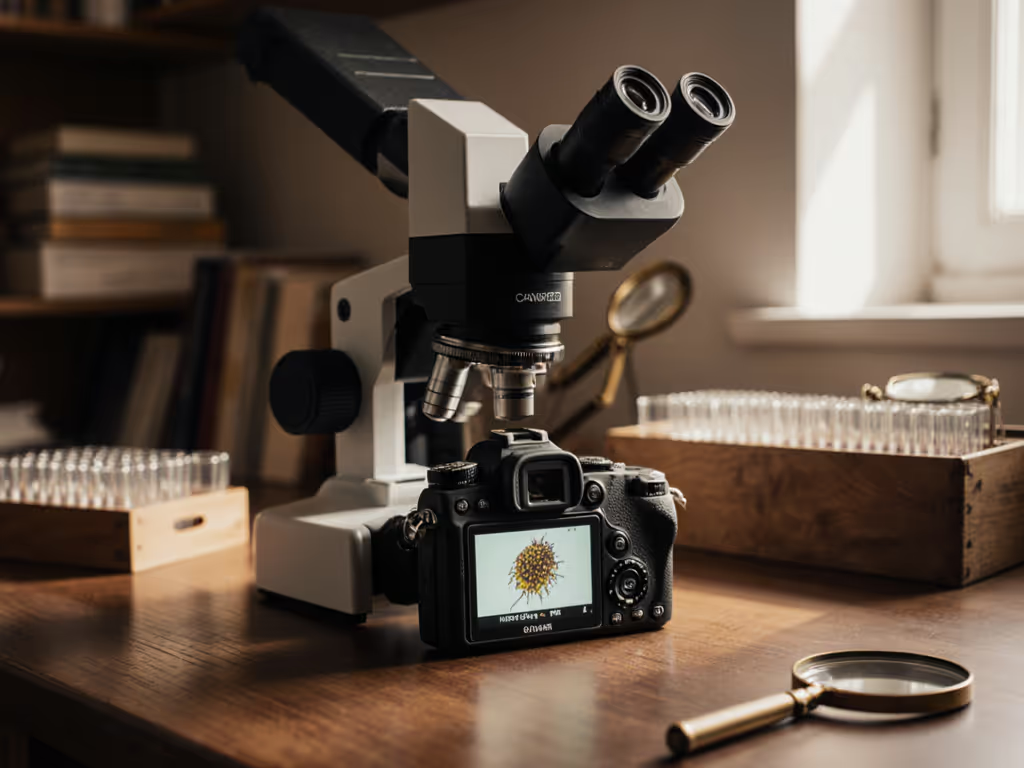
Here's how I approach the decision at a community lab: swap the cameras, measure contrast using a standard resolution target and basic image analysis software, document the noise levels under your actual lighting conditions, and note the file sizes and processing speed. Numbers tell the story; our eyes confirm the practical win.
Don't rely on specs alone. A CMOS sensor's quantum efficiency figure means little if it doesn't translate to usable detail in your specimens under your lighting. Download sample images from manufacturers, load them into free software like ImageJ, and measure signal to noise ratio yourself. To plan a streamlined acquisition-to-analysis workflow, see our microscopy workflow software guide. That's the test that predicts actual performance.
Key Specifications to Compare
| Metric | CCD Advantage | CMOS Advantage |
|---|---|---|
| Quantum Efficiency | Traditional, esp. in older designs | Modern (BSI), now competitive |
| Noise Level | Superior, esp. low speed operation | sCMOS now matches/exceeds high speed CCDs |
| Frame Rate | Slower, 10-30 fps typical | Faster, 30-500+ fps depending on design |
| Power Draw | Higher | Significantly lower |
| Cost | More expensive | More affordable |
| Dynamic Range | Typically higher | Improving, now competitive |
Moving Forward: What to Test First
If you're upgrading your microscopy camera, don't default to the cheapest option or the highest megapixel count. Before buying, learn why budget microscope cameras often disappoint so you can weigh long-term value against upfront savings. Instead, isolate what matters most for your work: speed, noise performance, light sensitivity, or cost effectiveness. Then request comparison samples or trial loans from manufacturers. Measure the metrics that align with your specimens and lighting.
The sensor you choose should amplify what your microscope's optics already deliver, not become a bottleneck. A poor sensor can waste the potential of excellent objectives and condensers. The right sensor (whether CCD or CMOS) turns your existing setup into something noticeably sharper and more capable.
Further Exploration
Your next step is identifying which imaging scenario defines your work. Are you documenting static specimens where exposure time isn't a constraint? Testing live behavior where speed is essential? Working in low light conditions where sensitivity is paramount? Once that's clear, request technical documentation and sample footage from camera manufacturers that match your use case. Many offer free evaluation periods, use them to measure actual performance against your specific specimens. That hands on comparison is worth more than any specification sheet.
Related Articles